Mot1on User Manual
Overview
Mot1on is a surround and immersive delay whose echoes can move through the room.
There are two engines for placing the echoes:
- MOTION — a moving-source delay. The dry signal becomes a point that travels along a chosen path, and the echoes trail behind it like a comet tail.
- STATIC — a multi-tap delay. A more standard type of surround delay: you place each tap at a fixed position around the room. The first repeat sounds from tap 1, the second from tap 2, and so on, and delay times and feedback can be set independently per tap, or globally.
The two engines are independent: each keeps its own GLOBAL timing, LENGTH, STYLE, MOD, and DECAY FILTER settings, so switching between them recalls that engine's complete setup.
On top of placement, Mot1on adds a delay-line character voice (STYLE), an independent modulation effect on the tail (MOD), and a moving tone filter on the tail (DECAY FILTER). It outputs to any speaker layout from mono and stereo up to full immersive 9.1.6, or to an ambisonic stream.
The plugin runs as VST3, AU, or AAX on macOS and Windows.
Choosing an engine and view
The DESIGN panel has two rows of buttons:
- Top row — the engine. MOTION or STATIC. Clicking one arms that engine; they are mutually exclusive.
- Bottom row — the view. Chooses which controls are shown for the armed engine: PATTERNS (MOTION's shape and path settings) or TAPS (STATIC's tap mixer, per-tap timing, LAYOUT / ORDER and SPK / FREE), plus STYLE and MOD. The first button reads PATTERNS in MOTION and TAPS in STATIC.
Easy Mode
The EASY button in the header (next to LIGHT) swaps the full interface for a compact face built around presets, for quick results without the deep controls. The button reads ADVANCED while easy mode is on; press it again to return to the full interface. Nothing is lost switching between the two, they are two views of the same settings.
The easy face has three panels:
- PRESET — the current preset's name, with arrows to step through the list, a click-to-open menu of all presets (in MOTION and STATIC columns, plus a USER column once you have saved your own), and a dice that rolls a random preset.
- TIME — the DELAY TIME readout (BARS or SEC) and the TEMPO readout (SYNC or FREE) with steppers, plus the FREEZE, TAP, TEST, and DT LOCK buttons.
- SETTINGS — FEEDBACK, MIX, HEIGHT, LO CUT, and HI CUT knobs, and the BEND fader.
Getting Started
- Insert Mot1on on a track or bus with a multichannel output (stereo, 5.1, 7.1.4, 9.1.6, etc.).
- Pick the matching layout from the OUT FORMAT dropdown in the header — or let Mot1on auto-detect it from the track's channel count.
- Arm an engine with the MOTION or STATIC button. Mot1on opens on MOTION.
- Set LENGTH in the GLOBAL panel for the time between repeats, then dial FEEDBACK for tail length and MIX for how much wet you hear.
- In MOTION, pick a SHAPE for the path. In STATIC, place taps on the dome or load a LAYOUT preset.
Output Formats
The OUT FORMAT dropdown in the header sets the speaker layout the delay plays to. The list covers channel beds with optional height beds, plus ambisonic encoding.
- Beds — from
1.0and2.0up through the standard surround formats (5.1,7.1,9.1), most available flat or with a height bed (.2,.4,.6top speakers), ending at immersive9.1.6. - Ambisonic —
1OAthrough7OAencode the moving delay into an ambisonic stream instead of driving discrete speakers, for binaural rendering, VR, or feeding a downstream decoder.
Details:
- Mot1on auto-detects the host bus layout and selects the matching format. Choosing a format by hand afterward simply overrides it.
- The
.2height beds place their two top speakers overhead-middle (directly above the listener), not forward. The.4beds use front and rear top pairs;.6adds the overhead-middle pair as well. - The 5.1 surrounds sit at the rear; 7.1 adds side surrounds as well.
- If you put a smaller mix on a larger bus, Mot1on lands the delay on the correct channels for that format and leaves the unused ones silent.
- LFE passes straight through. Mot1on never sends delay to the LFE channel, but any LFE present at the input is carried to the output untouched, so the low-frequency channel in a
.1mix stays intact.
Input Section
The vertical strip beside the stage holds the input gain meter and two buttons that decide how Mot1on reads the incoming audio.
Input gain
Drag the fader to set input gain. Double-click resets to 0 dB. The bars show live input level.
STEREO / MONO
The button reads MONO when engaged and STEREO otherwise. It collapses the input to a single point source before the delay. MONO is the default. Mot1on opens in MOTION, which is a single moving point, so a mono source is the natural starting point. Press for STEREO when you want to keep the source's width.
- In STEREO, MOTION keeps the source's left/right width as it travels: the moving head shows on the stage as a left/right pair, riding side by side across the path. MONO collapses it to a single moving point.
- Mutually exclusive with MULTI IN.
MULTI IN
Keeps each input channel at its own speaker position instead of folding the bus down to one source, so each channel gets its own delay whose echoes stay where that channel lives. Use it on a stereo or surround mix or stem where you want the input's spatial layout preserved.
- Each input channel routes to the output speaker nearest its own position. Where the chosen OUT FORMAT has no exact seat for a channel (for example a height channel played to a floor-only bed, or a 5.1 rear into a 7.1 layout), that channel folds onto the closest available speaker rather than being dropped.
- Behaves the same whether the taps are set to SPK or FREE.
- STATIC only. MULTI IN is disabled (and greyed) in MOTION, since a moving source is a single point.
- Mutually exclusive with MONO.
- Needs at least a stereo input; it greys out on a mono input.
The STAGE Visualizers
The STAGE panel shows the surround layout and the live delay. Two views are available from the tabs above it:
- CUBE — a rotatable 3D view of the room. Drag to rotate, scroll to zoom, RESET to recenter. Best for seeing height. Each tap glows in step with its own output level.
- TOP — a top-down dome view. In STATIC mode you place and drag taps directly on this view. In SPK the speaker positions are drawn as faint reference rings so you can see where each tap lands and which seats are empty.
In MOTION the moving source and its echoes animate along the path. In STATIC every placed tap is shown around the dome and lights up as it sounds. Because all the taps sound together, several can glow at once.
DIRECTION
The dial below the stage spins the whole spatial field around the listener, 0–359°. In MOTION it rotates the path and its comet tail; in STATIC it spins the freely-placed taps (taps locked to a speaker stay on their channel). The arrow shows where the front now points. It is fully automatable, so you can draw or record it in your DAW to orbit the field over time. Double-click to recenter (front).
MOTION Mode
MOTION turns the dry signal into a moving point source: it travels a chosen path while the echoes trail behind it, so the source sweeps through the room with a comet-like tail. Click the MOTION button to arm it.
- Mutually exclusive with STATIC: arming one disarms the other.
- FEEDBACK and MIX keep a small floor in MOTION. Even at zero a little of the moving delay always sounds, so MOTION stays a delay rather than collapsing into a plain panner.
SHAPE
The path the moving source travels. Pick one from the pattern grid:
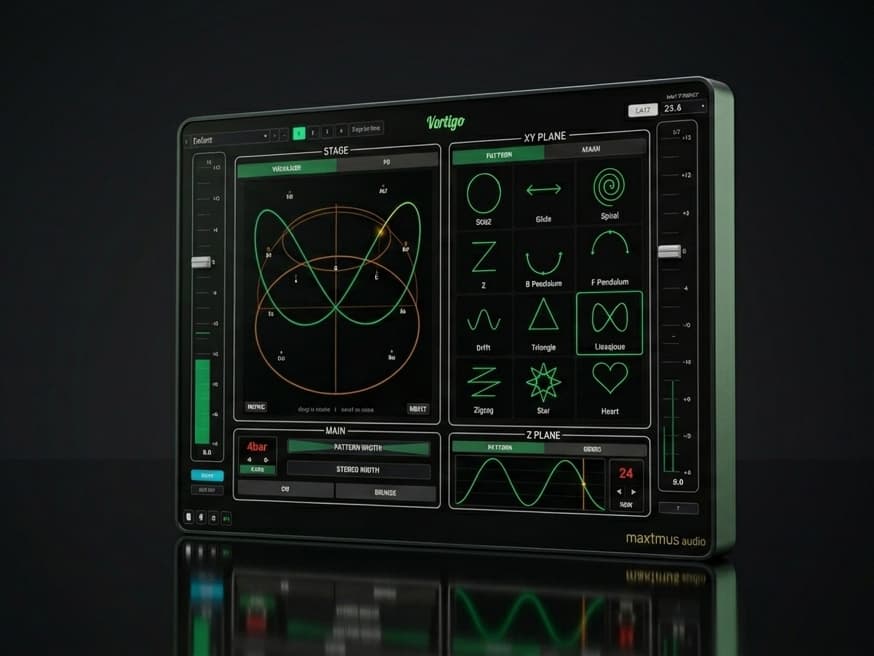
Comet, Vortex, Updraft, Pendulum, Figure-8, Throw, Flyover, Pinball, Drift.
Comet, Vortex, Updraft, Pendulum, and Figure-8 are orbiting shapes that loop around the room. Throw and Flyover travel from one place to another, and Drift wanders semi-randomly. Pinball bounces around the room in straight lines, reflecting off the walls, and off the floor and ceiling when HEIGHT is raised.
GLIDE / STEP
How the source advances along the path.
- GLIDE — the source moves smoothly and continuously.
- STEP — the source hops one position per delay repeat, so the movement is rhythmic and locked to the delay grid.
SUS / 1-SHOT
Sets how the echoes sit relative to the moving source. This is the companion to GLIDE / STEP: GLIDE / STEP controls how the source moves, SUS / 1-SHOT controls where its echoes land.
- SUS — the echoes trail behind the source like a comet tail, painting the path behind it. Best for sustained and pad material, where the trail spreads the sound across the room. This is the default.
- 1-SHOT — the echoes travel forward along the path instead of trailing. A single hit's repeats step one position further along the shape each time, so the hit itself ricochets around the room.
Travel direction — CW / CCW / BOUNCE
Sets which way the source travels along its path (distinct from the DIRECTION dial below the stage, which rotates the whole field).
- CW — the source loops clockwise (forward) around the path.
- CCW — the source loops counter-clockwise (reversed).
- BOUNCE — ping-pong: the source travels to the path end then reflects back. Combines with CW or CCW, which sets the starting direction.
LENGTH (motion rate)
How fast the source travels, one lap or pass of its path per cycle. Toggle the SYNC / FREE pill on the rate readout:
- SYNC — locks the lap length to a tempo division.
- FREE — sets the lap rate in Hz, ignoring tempo.
Detail controls
- WIDTH — how wide the path is: the orbit or travel radius around the room. For Pinball it sets the size of the room the source bounces in, and HEIGHT sets the ceiling it bounces up to.
- HEIGHT — lifts the path up into the height speakers (the global HEIGHT fader in the GLOBAL panel; applies to both modes).
- TRAIL — how many echoes trail the moving source: the length of the comet tail along the path. FEEDBACK sets how fast they fade; TRAIL sets how far they reach.
- TURNS — windings for Vortex. For Pinball it reads STEPS and sets the bounce density: higher values zig-zag off the walls more often per lap.
- ST WIDTH — with a stereo input, how far apart the left and right sit as they travel; the pair rides side by side across the path. Appears only with a stereo (non-mono) input.
STATIC Mode
STATIC is a multi-tap delay: each tap is one echo placed at a fixed position around the room. The first repeat always sounds from tap 1, the second from tap 2, and so on down the list. The order is the same every time no matter when you start playing. Click the STATIC button to arm it; its placement view is labeled TAPS.
- Mutually exclusive with MOTION.
Placing taps
Switch the STAGE to the TOP view and work with taps directly on the dome:
- Click an empty slot to drop a tap.
- Click a tap to select it (its height then shows on the TAP HEIGHT strip).
- Drag a tap to move it.
- To remove a tap, rest the pointer on it for a moment: a small close (×) badge appears at its corner; click the badge to delete it.
- Taps can share one position, stacking echoes on a single spot. A stack shows a small ×2 or ×3 count beside the dot; rest the pointer on it and the taps fan out in a ring so you can select, drag, or delete each one. Move the pointer away and they collapse back to the shared spot.
SNAP
Shown only in FREE placement. In SPK every tap already sits on a speaker, so SNAP is redundant and hidden there. It is a single switch that quantizes free placement for both the dome (angular grid, distance rings, and speaker positions) and the TAP HEIGHT strip. Off by default, for completely free placement.
- With SNAP on, a tap dropped near a real speaker snaps onto it and routes straight to that channel; elsewhere it locks to the grid.
- With SNAP off, taps sit exactly where you place them and are panned to that position.
LAYOUT presets
The LAYOUT dropdown arranges all the taps into a shape in one move: rings, spirals, stars, grids, sweeps, and more (CW, CCW, Spiral In/Out, Star, Cross, Diagonal, Grid, Scatter, Front Arc, Rear Arc, Left/Right Sweep, Double Ring, Pinwheel, Figure-8, Diamond, Bounce, Wide, and Speaker Bed). Most are free positions you can then drag; Speaker Bed binds the taps to the ear-level speakers. Editing taps by hand sets the layout to Custom.
- The arrows either side of the dropdown step to the previous / next layout, so you can audition them quickly.
POSITION — SPK / FREE and INC TOPS
Decides whether taps are pinned to real speakers or placed freely. STATIC opens in SPK with INC TOPS on.
- SPK — every tap snaps to a real speaker channel for a clean bed routed straight to the layout. This is the default.
- FREE — taps are placed freely around the room and panned to position.
- INC TOPS — in SPK mode only, include the top/height speakers in the set taps can land on. On by default.
While SPK + INC TOPS is active the taps are pinned to the speakers' fixed heights, so the global HEIGHT fader is greyed out. In every other STATIC state, HEIGHT works just as it does in MOTION.
The Tap Mixer
The tap mixer to the side of the stage controls level, mute, solo, and order for the taps. Each tap is one echo, and the order sets which position each successive repeat lands on — the top strip is the first repeat, the next strip the second, and so on.
- SEL — the drag handle. Drag a strip to reorder the taps; click to select a tap (so its height shows on the TAP HEIGHT strip), click again to deselect.
- Selecting more than one tap — hold Ctrl (or Cmd) and click to add or remove individual taps from the selection, or hold Shift and click to select every tap between the last-selected one and the one you click. With several taps selected, moving any one fader moves them all together (keeping their relative balance), and clicking M or S applies to the whole selection. The per-tap TIME, FEEDBACK, and HEIGHT overrides also apply across the whole selection, so you can set a group of taps to the same division, feedback, or height in one move. The brightest-outlined strip is the one whose height the TAP HEIGHT strip edits.
- Level fader — per-tap level, with a dB readout.
- M — mute the tap.
- S — solo the tap.
- LINK — gang all faders so they move together.
- CLR M / CLR S — clear all mutes / all solos.
- − / + — remove or add a tap, changing how many echoes are in the mix (up to 16).
Per-tap TIME and FEEDBACK overrides
The SELECT TAP strip lets the selected tap break away from the global timing and have its own. Select a tap in the mixer first, then:
- TIME — click to pick a delay division for just this tap, or choose GLOBAL to follow the global DELAY TIME.
- FEEDBACK — drag the slider to set this tap's feedback; double-click to return it to GLOBAL.
An overridden tap leaves the main sweep and becomes its own echo voice.
TAP HEIGHT strip
When the STAGE is on the TOP view, the vertical TAP HEIGHT strip sets the selected tap's own height (as opposed to the global HEIGHT fader, which moves all of them) — bottom is ear level, top is overhead. With SNAP on it locks to the marked levels.
It works like the per-tap TIME and FEEDBACK overrides:
- The GLOBAL button lights green and the fill is green when the tap follows the global HEIGHT fader: move that fader and the tap rises and falls with it.
- Drag the strip to give this tap its own fixed height. The fill turns orange, the readout shows that height, and the tap no longer follows the global fader.
- Double-click the strip (or the GLOBAL button) to hand the tap back to GLOBAL.
GLOBAL Panel
The GLOBAL panel sits below the STAGE and holds the master delay timing and feedback controls. These are per-engine: MOTION and STATIC each keep their own LENGTH, TEMPO, FEEDBACK, MIX, SWING, POCKET, BEND, and HEIGHT.
LENGTH (DELAY TIME)
The time between repeats. Drag, scroll, or double-click the value to type it.
- BARS — locks the delay time to tempo divisions (1/32 up to 64 bars).
- SEC — sets the delay time as free milliseconds, ignoring tempo.
TEMPO
Where the master tempo comes from, shown next to the LENGTH box.
- SYNC — follows the host tempo.
- FREE — set the tempo manually, by typing it or using TAP.
- TAP — tap a few times to set the tempo (switches TEMPO to FREE). Greyed out while on SYNC.
- DT LOCK — locks the delay time so preset loads and the dice leave it alone. You can still edit DELAY TIME by hand while locked; the edit becomes the new locked value.
FEEDBACK / MIX / SWING / POCKET
- FEEDBACK — tail length. Each repeat steps to the next position and fades by this amount.
- MIX — dry/wet balance. 100% wet on a send; lower it as an insert.
- SWING — groove for the repeats. Lengthens every other echo and shortens the next; positive swings the off-beats later, negative earlier; 0 is straight.
- POCKET — feel against the grid. Negative pulls the repeats late and laid-back, positive pushes them early and ahead.
BEND
The vertical, center-detented fader. A tape-style varispeed on the delay: pull it down and the repeats slow and dip in pitch, like slowing a reel; push it up and they speed up and lift. The pitch shift lasts as long as you hold the fader off center, up to an octave each way, and the dry signal is untouched. Release and it springs back to center, gliding the tail back to normal. Fully automatable.
Only BEND changes pitch. LENGTH, POCKET, and SWING all change the timing of the repeats cleanly, without affecting pitch; BEND is the one control that bends the tail's pitch as it changes the time.
HEIGHT
The vertical fader for vertical placement: it lifts both the MOTION path and the TAPS up into the height speakers. Applies to both modes. Greyed out only in TAPS when SPK + INC TOPS pins the taps to fixed speaker heights.
In TAPS, individual taps follow this fader by default but can be given their own fixed height on the TAP HEIGHT strip (see TAP HEIGHT strip above); those taps then ignore the global fader.
STYLE
STYLE sets the delay's voice, the character or medium of the echoes, without changing where they are placed. It applies in both MOTION and STATIC, which each keep their own choice, and is always on, defaulting to the clean Digital voice.
The twelve voices:
Digital, Tape, Bucket Brigade, Magnetic Drum, Oil Can, Vintage Digital, Lo-Fi, Dub, Reverse, Shimmer, Granular, Cassette.
Digital is transparent and neutral; the others color the tail in the manner their name suggests.
MOD
MOD adds a flange, phaser, or chorus effect to the wet delay tail. It has its own power button on the MOD view, and each engine keeps its own MOD settings — MOTION and STATIC can run different modulation independently.
- Mode — FLANGE / PHASER / CHORUS (mutually exclusive).
- RATE — LFO speed. Toggle SYNC (tempo divisions) / FREE (Hz) on the pill.
- SHAPE — LFO waveform: Sine / Triangle / Saw / Square. The waveform display shows the live phase.
- DEPTH — modulation amount.
- FBK — feedback into the flanger/phaser comb (resonance).
- WIDTH — spreads the LFO across channels for cross-channel movement.
- MIX — dry/wet of the modulation effect.
DECAY FILTER
DECAY FILTER shapes the tone of the delay tail. The yellow LO and HI bars are a filter on the wet signal, cutting below and above them, and the green curve sweeps a moving low-pass inside that band over time, so the tail can move from bright to dull (or any shape you draw) as it repeats.
- The green curve is the tail's moving low-pass over the LENGTH loop. Drag a point to move it, double-click empty space to add a point (up to five), right-click or select-and-Delete to remove one.
- The yellow bars cut the wet signal outside them: LO removes lows below it, HI removes highs above it, and the curve sweeps within the band they set. The POS strip on the left moves the whole band up or down while keeping its span.
- LENGTH — the loop length of the tail-tone curve, tempo-synced. Use the arrows or drag/scroll the digits to step through values; click the chevron for the full list.
- DEFAULT — reset the curve to the gentle bright-to-dull default and re-open the band.
- OFF — flatten the curve to a straight line at the top: full-band, no tail filtering.
RANDOM
The dice button (under the ? beside the output meter) rolls a fresh set of settings for whichever engine is armed (timing, width, trail, tone, and more) for instant inspiration without losing your place in the layout.
- It randomizes within the current engine only; it never switches between MOTION and STATIC.
FREEZE / TEST
- FREEZE — captures and loops a slice of the delay. Press and hold, and the button turns red while Mot1on samples the audio; the length of your hold sets the length of the loop. Release, and the button turns green and the captured slice loops, ignoring new input; the motion keeps moving. Press again to switch it off and return to normal delay. Automatable.
- TEST — fires a short audition burst through the delay; press again to restart it and cut a ringing tail. In MOTION with SUS, the burst repeats on 1/8 notes for one LENGTH lap, so the moving source draws its whole path.
Presets
The preset browser in the header holds 200 factory presets in one numbered list: 001–100 are MOTION presets and 101–200 are STATIC presets. Loading one recalls a complete setup for its engine, including placement, timing, STYLE, MOD, and DECAY FILTER.
- The dropdown shows the presets in MOTION and STATIC columns, with a separate USER column once you have saved your own; the arrows step to the previous or next preset.
- The A/B/C/D slots hold four setups you can flip between to compare.
- The ⋯ menu saves the current settings as a user preset, and exports or imports presets as files.
- An asterisk after the preset name means you have edited settings since loading it.
- DT LOCK keeps the delay time fixed while you audition presets (see the GLOBAL panel).
Licensing
Click the key icon in the footer to manage your license. From the dialog you can:
- Activate a license key
- Start a trial
- Open the purchase page in your browser
Tooltips & Help Mode
Mot1on has a built-in help mode that turns every control into an inline tooltip — handy while you're learning the plugin.
Press the ? button in the header to turn help mode on; the button highlights to show it's active. Hover any control to read its tooltip. Press ? again to switch it off.
Support
- Use the ? help mode above for inline help on any control.
- Click the book icon in the footer to open this manual.
- Click the lightbulb icon to send a feature request.
- Click the bug icon to report an issue.
- Visit max1musaudio.com for support, downloads, and account management.